Most homeowners don’t think about their water heater until it starts causing problems. Running out of hot water mid-shower, rising energy bills, or a bulky tank taking up space in the garage are usually the tipping points. That’s when tankless systems start coming into the conversation.
Switching to a tankless water heater isn’t just about upgrading equipment. It’s about changing how your home produces hot water. Instead of storing and reheating water all day, you get it on demand, when you actually need it. That shift alone changes efficiency, space usage, and long-term costs. The real question is not whether tankless systems are better. It’s whether they make sense for your home and how well they are installed.
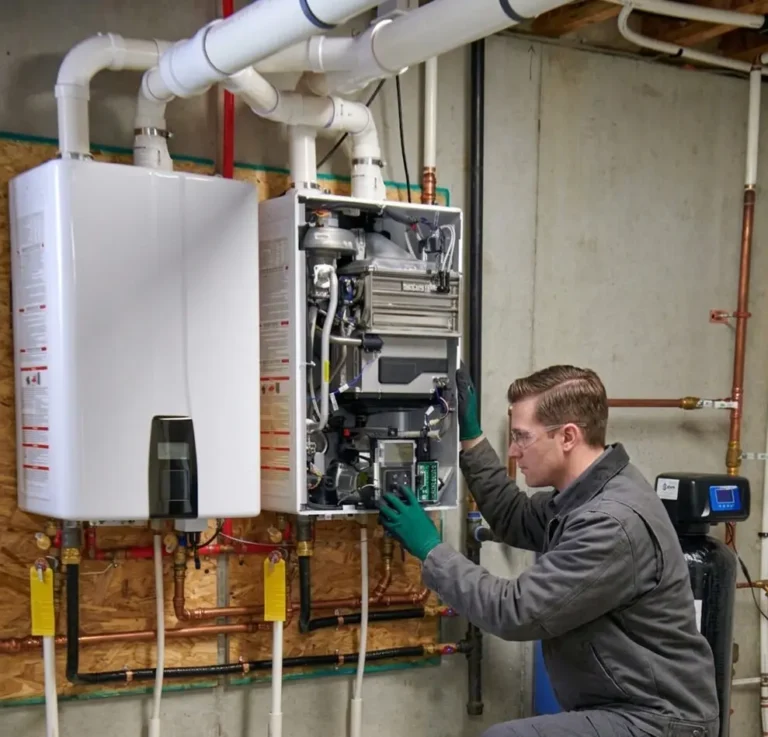
There has been a steady shift away from traditional storage tanks, and it is not driven by trends. It comes down to practicality. Traditional water heaters heat and store a fixed amount of water, then keep reheating it to maintain temperature. That means energy is being used even when no one is running a tap. Over time, that constant standby heating adds up.
Tankless systems remove that inefficiency. Water is heated only when needed. No storage, no idle energy use, no waiting for a tank to refill. Space is another factor. A standard tank takes up a noticeable footprint, especially in smaller homes or utility areas. Tankless units are compact and wall-mounted, freeing up space that can actually be used. From what we see at DG Plumbing Services, most homeowners who switch are not chasing features. They are solving a problem. Either they want consistent hot water, lower operating costs, or simply more usable space.
A tankless water heater operates on demand, but the process behind that “instant hot water” is more precise than it sounds. When you open a hot water tap, cold water enters the unit and passes through a heat exchanger. At the same time, a flow sensor detects movement and signals the system to activate heating immediately.
There is no storage and no idle heating cycle. The system only consumes energy when water is flowing, which removes one of the biggest inefficiencies found in traditional tanks.
At the core of this process are two critical components working together:
A flow sensor that measures water movement, typically activating at flow rates as low as 0.5 to 0.7 gallons per minute
A high-efficiency heat exchanger designed to transfer heat rapidly while water is moving through the system
This is why tankless systems require high power input, either through gas burners or electric heating elements. The energy is delivered instantly rather than spread over time.
Because there is no stored hot water, standby heat loss is eliminated. Traditional tank systems continuously lose heat through the tank walls, even when no water is being used. Tankless systems avoid this entirely, which is why their efficiency ratings can reach 90% to 98% depending on the model.
However, performance is directly tied to sizing and flow demand. A tankless unit is limited by how much heat it can deliver at a given moment. If multiple fixtures are used at the same time, the system must divide its output across those demands.
For example:
| Flow Scenario | Total Demand (GPM) | Required Output (kW) | Result if Undersized |
|---|---|---|---|
| Single shower | 2.0 to 2.5 | 12 to 18 kW | Stable performance |
| Shower + kitchen sink | 3.5 to 4.0 | 20 to 28 kW | Slight temp drop |
| Two showers + appliance | 5.0 to 6.5 | 30 to 45 kW | Noticeable drop |
If the unit cannot meet the required heat output, water temperature will drop rather than flow stopping. This is why undersized systems often feel inconsistent during peak use.
In practical terms, tankless performance is not just about the unit itself. It is about matching the system’s heat capacity to your home’s peak demand. That requires understanding how many fixtures are used at once, the incoming water temperature, and the desired output temperature.
This is where proper planning becomes critical. A well-sized system delivers consistent, efficient performance. An undersized one turns a good upgrade into a frustrating experience.
The biggest advantage is consistency. You are no longer limited by tank capacity. Once the system is running properly, hot water does not run out. Showers, appliances, and multiple fixtures can operate without the usual drop in temperature that happens with storage tanks.
There are also long-term efficiency gains. Since water is heated only when needed, energy usage becomes more controlled. Over time, this can reduce operating costs, especially in households with moderate to high usage. Then there is space. A wall-mounted unit replaces a bulky tank, opening up room in garages, closets, or utility areas. For many homeowners, this alone is a practical upgrade.
However, not every home will see the same level of savings. Usage patterns, installation quality, and system sizing all play a role. The benefits are real, but they depend on doing the upgrade correctly.
Before switching, it is worth taking a step back and looking at how your home actually uses hot water. If your household frequently runs multiple showers, appliances, and taps at the same time, a properly sized tankless system can handle it. If not sized correctly, performance will drop, and the upgrade will feel like a downgrade.
Your existing setup also matters. Gas lines, electrical capacity, and ventilation all influence how straightforward the installation will be. Some homes require upgrades before a tankless unit can be installed safely and effectively. Cost is another factor. Tankless systems typically have a higher upfront cost compared to traditional tanks. The return comes over time through efficiency, lifespan, and reduced maintenance issues.
This is where a proper assessment makes a difference. At DG Plumbing Services, we look at actual usage, not assumptions, before recommending a system. That avoids undersizing, overspending, or installing something that does not match your needs.
The performance of a tankless system is heavily dependent on installation. Even the best unit will underperform if it is not set up correctly. Sizing is the first step. The system must match your home’s peak demand, not just average usage. Undersized units are one of the most common issues we see.
Then comes infrastructure. Gas-powered units may require upgraded gas lines to deliver enough fuel. Electric systems may need higher-capacity circuits. Ventilation must also be properly configured to meet safety standards.
These are not optional details. They directly affect performance, efficiency, and safety. At DG Plumbing Services, installation is approached as a full system setup, not just a unit swap. That means checking capacity, confirming compatibility, and making sure everything is configured to perform as expected from day one.
The choice between tankless and traditional systems comes down to how you value upfront cost versus long-term performance. Traditional tanks are less expensive to install and simpler to replace. However, they use more energy over time and have a shorter lifespan due to constant heating and internal wear. Tankless systems cost more upfront but offer longer service life and better efficiency. They also eliminate the risk of running out of hot water, which is one of the main limitations of storage tanks.
Maintenance requirements differ as well. Tankless units require periodic servicing to prevent scale buildup, especially in areas with hard water. Traditional tanks require flushing and component checks but tend to degrade faster internally. There is no one-size-fits-all answer. The better option depends on your priorities, usage, and long-term plans.
Switching to a tankless water heater can improve efficiency, free up space, and provide consistent hot water, but only if it is done correctly. Rushed installations and incorrect sizing are where most problems start. What should have been an upgrade ends up causing frustration instead. If you are considering making the switch, it is worth getting a proper assessment first.
At DG Plumbing Services, we help homeowners choose the right system, size it correctly, and install it with everything configured to perform as expected. No guesswork, no shortcuts, just a setup that works the way it should. If you are ready to upgrade or want to know if tankless is the right move for your home, call (832) 274-3257 and get clear answers before making the decision.
Do tankless water heaters struggle when multiple taps are used at once?
They can, but it depends on the unit size. A properly sized system can handle simultaneous use, but an undersized one will struggle. This is why sizing matters more than the brand itself.
Why does tankless hot water sometimes take longer to reach the tap?
Tankless systems heat water instantly, but they don’t store it. The delay you notice is usually from the distance between the heater and the tap, not the unit itself.
Is the water pressure different with a tankless system?
The system does not create pressure. It works with your home’s existing pressure. However, if the unit is undersized, it can limit flow, which feels like reduced pressure.
Can I install a tankless unit in the same spot as my old tank heater?
Sometimes yes, but not always. Tankless units often need different venting, gas supply, or electrical capacity. A direct swap is possible in some setups, but not guaranteed.
Do tankless water heaters require more maintenance than tank systems?
They require a different type of maintenance. Instead of dealing with tank sediment buildup, tankless systems need periodic descaling to prevent mineral deposits inside the heat exchanger.
What happens if the power goes out? Will I still have hot water?
If it’s an electric tankless system, it will not operate without power. Gas models also rely on electrical components for ignition, so they usually won’t run during outages either.
Is it true that tankless systems last longer than traditional tanks?
In most cases, yes. Tankless units can last significantly longer because they don’t store water, which reduces internal corrosion. However, lifespan still depends on maintenance and usage.
Will switching to tankless noticeably lower my energy bill?
It can, especially in homes with consistent hot water usage. The savings come from eliminating standby heat loss, but the actual reduction depends on how often and how much hot water you use.
Atascocita | Baytown| North Houston| Crosby| Kingwood | Porter | Spring | New Caney
Plumber in Humble, TX offering a wide range of services including leak detection, water heater installation, and emergency repairs.
