Choosing between a tank and a tankless water heater is not a feature comparison. It is a decision about how your home uses water under real conditions. Most homeowners focus on labels like “endless hot water” or “energy efficient” without understanding how those claims perform when multiple fixtures are running, pressure fluctuates, or demand spikes.
Both systems solve the same problem in different ways. One stores and manages supply. The other reacts instantly to demand. The difference shows up during daily use. Morning routines, simultaneous showers, appliance cycles, and recovery time all expose how each system behaves under load. The right choice depends less on preference and more on how consistently the system can match your actual usage pattern.
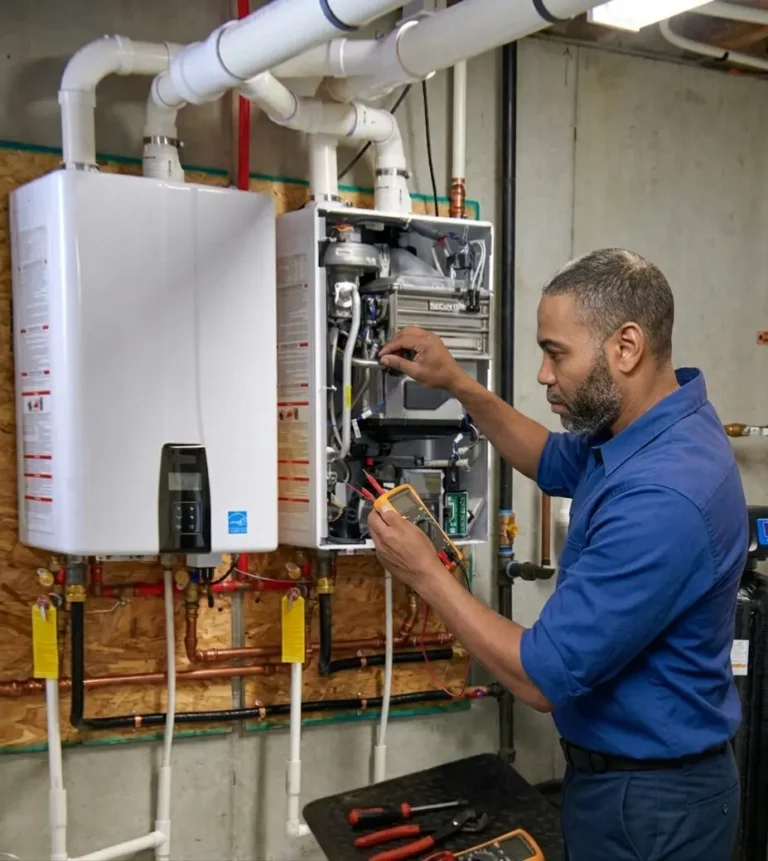
A tank water heater works by maintaining a reserve of heated water. The system heats a fixed volume and keeps it ready for use. When hot water is drawn, cold water enters the tank and reduces the overall temperature. The system must then recover by reheating the incoming water. This creates a cycle of depletion and recovery that depends on tank size and heating capacity.
Tankless systems remove storage entirely. Water is heated only when needed as it passes through the unit. There is no reserve, which means there is no recovery time in the traditional sense. Instead, performance depends on how quickly the system can heat water at the moment of demand. This shifts the limitation from storage capacity to heating power and flow rate. Under low demand, both systems perform well. The difference appears when demand increases. A tank system runs out of stored water. A tankless system reaches its maximum heating capacity. Both have limits, but those limits behave differently.
Daily usage patterns determine how each system performs. In a household where hot water is used one fixture at a time, tankless systems maintain consistent output without interruption. There is no waiting for recovery, and supply remains continuous.
In homes where multiple fixtures run at once, performance becomes more complex. A tank system distributes stored hot water across all active outlets until the reserve is depleted. Once depleted, recovery time becomes the bottleneck. A tankless system, on the other hand, divides its heating capacity across all active flows. If demand exceeds capacity, temperature drops.
The difference is not about which system is better. It is about how each system handles peak demand. Tank systems struggle with duration. Tankless systems struggle with simultaneous load. Understanding how your household uses water at peak times determines which limitation matters more.
Cost differences between tank and tankless systems become clear only when you look beyond installation and evaluate how each system behaves over time. Upfront pricing is only one part of the equation. Long-term cost is shaped by energy use, lifespan, maintenance, and replacement frequency.
A standard tank water heater typically costs between $800 and $1,500 installed, depending on size and accessibility. In contrast, a tankless system usually ranges from $2,000 to $4,500 installed, especially when upgrades to gas lines, venting, or electrical capacity are required. This creates an upfront cost ratio of roughly 1 : 2.5–3 (tank vs tankless).
That ratio often discourages homeowners from considering tankless systems, but it does not reflect how cost evolves over time.
Tank systems maintain stored hot water continuously. This creates standby energy loss, meaning energy is consumed even when no hot water is being used. Tankless systems eliminate this by heating water only during demand. However, this advantage depends on usage. In homes with constant hot water use, tankless systems operate more frequently at full capacity, reducing the efficiency gap.
Lifespan shifts the cost structure further. Tank systems typically last 8 to 12 years, while tankless systems can last 15 to 20 years with proper maintenance. Over a 20-year period, a tank system will likely be replaced once, while a tankless system may still be in operation. This introduces a replacement ratio of approximately 2 : 1 (tank vs tankless over 20 years).
| Cost Component | Tank Water Heater | Tankless Water Heater |
|---|---|---|
| Initial Installation | $800 – $1,500 | $2,000 – $4,500 |
| Lifespan (avg) | 10 years | 18 years |
| Units Needed (20 yrs) | 2 | 1 |
| Total Equipment Cost | $1,600 – $3,000 | $2,000 – $4,500 |
| Annual Energy Cost | $450 – $700 | $300 – $550 |
| 20-Year Energy Cost | $9,000 – $14,000 | $6,000 – $11,000 |
| Maintenance (20 yrs) | $300 – $800 | $800 – $1,500 |
| Estimated Total Cost | $10,900 – $17,800 | $8,800 – $17,000 |
Physical space plays a direct role in system selection. Tank systems require floor space to accommodate the storage unit. Larger tanks increase capacity but also increase space requirements. Installation location must support the weight and size of the unit.
Tankless systems are compact and can be mounted on walls, making them suitable for limited space environments. However, installation is not always straightforward. Proper ventilation, gas supply, or electrical capacity must be available. In some cases, installation complexity offsets the benefit of reduced physical size.
Space efficiency is not just about dimensions. It includes how the system integrates into the home without requiring major structural or utility changes.

Energy use in water heaters is determined by how heat is generated, stored, and maintained under real operating conditions. Tank systems maintain a constant volume of heated water, which requires continuous energy input. Heat is lost through the tank walls and surrounding environment, forcing the system to cycle on and off to maintain temperature. This loss occurs regardless of demand. Even when no hot water is used, energy is still being consumed to preserve stored heat.
This standby loss becomes more significant over time. The longer the system sits without usage, the more energy is wasted maintaining temperature. In households with irregular or low hot water usage, this creates unnecessary consumption that does not translate into actual output.
Tankless systems operate without storage, removing standby heat loss entirely. Water is heated only when it flows through the unit, which aligns energy use directly with demand. Under controlled usage, this results in lower overall consumption because energy is only used when needed.
However, performance changes under load. During periods of high demand, tankless systems operate continuously at full capacity. Heating elements or burners remain active for longer durations, increasing energy draw during those periods. The system becomes demand-driven rather than cycle-driven, which shifts how energy is consumed rather than eliminating it entirely.
Efficiency is not an absolute advantage tied to system type. It is a result of how closely the system’s operation matches usage patterns. Tank systems distribute energy use across time, including idle periods. Tankless systems concentrate energy use during active demand. The difference becomes measurable only when usage behavior is considered.
Homes with intermittent usage patterns tend to benefit from on-demand heating, where energy is not wasted maintaining unused water. Homes with sustained or high simultaneous demand reduce the efficiency gap, as both systems operate near their capacity limits during peak use.
Tank systems typically have a shorter lifespan, often around 8 to 12 years, due to internal corrosion and continuous exposure to heated water. Sediment buildup accelerates wear and reduces efficiency over time.
Tankless systems generally last longer, often exceeding 15 to 20 years, because they do not store water continuously. However, they are more sensitive to water quality and require regular maintenance to prevent scale buildup within heat exchangers.
Maintenance differs in approach. Tank systems require flushing to remove sediment. Tankless systems require descaling to maintain performance. Neglecting maintenance in either system leads to efficiency loss and reduced lifespan.
Selecting between a tank and tankless water heater cannot be reduced to unit comparison. Performance depends on how the system interacts with your home’s plumbing, demand patterns, and available infrastructure. Pressure behavior, pipe layout, and simultaneous usage all influence how the system will perform once installed.
Water demand is not constant throughout the day. Peak usage periods place the highest load on the system, and that is where mismatched installations begin to fail. A system that performs well under light use can struggle when multiple fixtures run at once. This is often where tankless systems are undersized or tank systems are incorrectly selected for capacity. The result is not system failure, but consistent underperformance that affects daily use.
Infrastructure also plays a direct role. Tankless systems require adequate gas supply or electrical capacity to maintain output under demand. Tank systems require sufficient space and proper pressure configuration to operate efficiently. Ignoring these requirements leads to systems that function, but never perform at their intended level.
At DG Plumbing Services, system selection is based on actual operating conditions, not assumptions. We evaluate how your system handles pressure, how demand builds across the day, and whether your setup can support the system you are considering. This prevents mismatched installations that lead to long-term performance issues.
If you are deciding between tank and tankless, or planning an upgrade, call (832) 274-3257. We assess the full system and recommend a setup that performs consistently under real usage, not just on paper.
Which system lasts longer, tank or tankless?
Tankless systems generally last longer due to reduced internal corrosion, but proper maintenance is required to maintain performance.
Do tankless systems really provide unlimited hot water?
They provide continuous heating, but output depends on system capacity. High simultaneous demand can reduce performance.
Is a tank system cheaper overall?
Upfront cost is lower, but long-term cost depends on energy use, maintenance, and replacement frequency.
Can a tankless system handle multiple showers at once?
Only if it is properly sized. Undersized systems will struggle under simultaneous demand.
Which system is better for small homes?
Tankless systems work well in small homes due to space efficiency, but usage patterns still determine suitability.
Do tank systems waste energy?
They can lose energy through standby heat loss, especially if hot water is not used frequently.
Is installation more complex for tankless systems?
Yes. They often require upgrades to gas lines, electrical systems, or ventilation.
How do I decide which system fits my home?
Evaluate your peak usage, available space, and infrastructure. System selection should match actual demand, not assumptions.
Atascocita | Baytown| North Houston| Crosby| Kingwood | Porter | Spring | New Caney
Plumber in Humble, TX offering a wide range of services including leak detection, water heater installation, and emergency repairs.
