A hot water heater does not usually fail out of nowhere. It slows down first. Showers take longer to heat. Hot water runs out faster than it used to. Sometimes there is a faint noise that you ignore because everything still “works.” That is where most problems begin.
By the time the system completely stops, the issue has already been building for months. We see this pattern all the time. Homeowners wait, try a few quick fixes, and hope it stabilises. Sometimes it does. Most times, it does not. Understanding how to repair a hot water heater is not just about fixing it when it breaks. It is about knowing what is actually happening inside the tank and deciding early whether the fix is simple or not worth delaying.
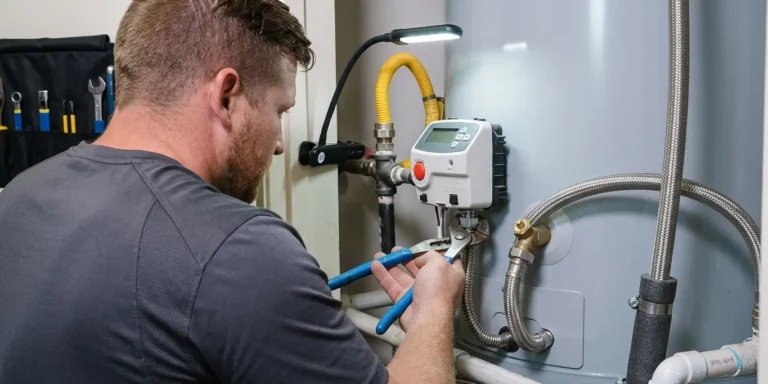
Inside every water heater, there is a slow process you cannot see. Minerals in the water settle at the bottom of the tank and form a layer that hardens over time. That layer blocks heat transfer, which forces the system to work harder just to maintain the same output.
At the same time, protective components wear out. The anode rod corrodes by design, but once it is depleted, corrosion moves to the tank itself. Heating elements struggle, thermostats drift, and pressure components take on more stress than they were built for.
From our experience at DG Plumbing Services, most systems we inspect are not “broken.” They are worn, strained, and close to failure. The difference matters, because worn systems can still be repaired. Failed ones usually cannot.
Jumping into repairs without knowing the problem is where time and money get wasted. The system gives clues. You just need to read them correctly.
These are not random symptoms. They follow patterns. The more accurately you identify the issue, the simpler the repair becomes.
We often get calls where parts have already been replaced, but the original problem is still there. That usually comes down to misdiagnosis, not complexity.
Some repairs are straightforward if you stay within limits. The key is knowing where those limits are.
Resetting the system is often the first step. If a high-limit switch has tripped, a simple reset can restore hot water. If it trips again, that is your signal to stop and investigate further.
Relighting a pilot light is another common fix for gas units. It is simple when it works. If it does not stay lit, the issue is deeper, and forcing it usually leads nowhere.
Flushing the tank can improve performance, especially in homes where sediment builds up quickly. A proper flush removes loose deposits and can restore heating efficiency almost immediately. However, once sediment becomes compacted, basic draining will not fully solve the problem.
Replacing a heating element is possible, but only if you are certain it has failed. Swapping parts without confirmation is one of the most common mistakes we see.
DIY repairs work best when the issue is minor and clearly identified. Once things become uncertain, continuing usually adds more problems than it solves.
There is a point where continuing to troubleshoot on your own stops being practical. Most homeowners reach it after spending time on fixes that do not hold. If you are dealing with repeated loss of hot water, visible corrosion, or any form of leaking from the tank itself, the issue is no longer surface-level. Electrical faults and gas-related problems also fall into this category.
At DG Plumbing Services, a large part of our work comes from situations where early intervention would have kept the repair simple. Instead, the system was pushed until failure. Calling a professional is not about giving up on a repair. It is about making sure the repair is done once and done correctly.
A proper repair is not just about replacing what failed. It is about understanding why it failed in the first place.
If a heating element burns out because of sediment buildup, replacing it without removing the sediment means the new element will fail again. The same applies to thermostats and valves. The root cause must be addressed, or the problem repeats.
This is where experience makes a difference. At DG Plumbing Services, we approach repairs by looking at the full system, not just the faulty part. That allows us to fix the issue in a way that lasts.
Most repairs, when diagnosed correctly, can be completed quickly. What takes time is getting to the right diagnosis in the first place.
Not every water heater should be repaired. Some are simply at the end of their lifecycle.
If the unit is older and starting to show multiple issues, repairs can become a short-term solution with long-term costs. Corrosion inside the tank is usually the deciding factor. Once it starts, there is no real way to reverse it.
At the same time, many systems still have years left in them with the right repairs and maintenance. The challenge is knowing which situation you are in.
We do not push replacement unless it makes sense. In many cases, a targeted repair restores performance and avoids unnecessary expense.
When a water heater fails, it is not something you can ignore for long. It affects daily use immediately, and delays tend to make things worse.
If your system is showing signs of trouble or has already stopped working, it is worth getting it checked early. At DG Plumbing Services, we handle water heater repairs with a focus on accurate diagnosis and efficient solutions.
Some repairs are simple. Others are not. The important part is knowing which one you are dealing with before it turns into a bigger problem.
If your water heater is not performing the way it should or has already stopped working, it is worth having it checked before things get worse.
At DG Plumbing Services, we focus on accurate diagnosis and straightforward repairs. No unnecessary replacements, no guesswork, just clear answers and work that holds up.
Call DG Plumbing Services at (832) 274-3257 or book a service visit today. It is a simple step that can save you from a much bigger repair later.
Atascocita | Baytown| North Houston| Crosby| Kingwood | Porter | Spring | New Caney
Plumber in Humble, TX offering a wide range of services including leak detection, water heater installation, and emergency repairs.
