A leaking water heater is never just a surface problem. By the time water becomes visible around the unit, internal conditions have already shifted. Pressure has built beyond stable limits, materials have weakened, and the system is no longer operating under controlled conditions. The visible leak is only the final stage of a process that has been developing over time.
Water escaping from the system does not stay contained. It moves into surrounding materials, affecting flooring, insulation, and structural components. Damage begins immediately and compounds with time. What starts as a small leak can quickly expand into a larger repair involving both plumbing and property restoration. Identifying the source early determines whether the issue can be contained or whether the system has already reached structural failure.
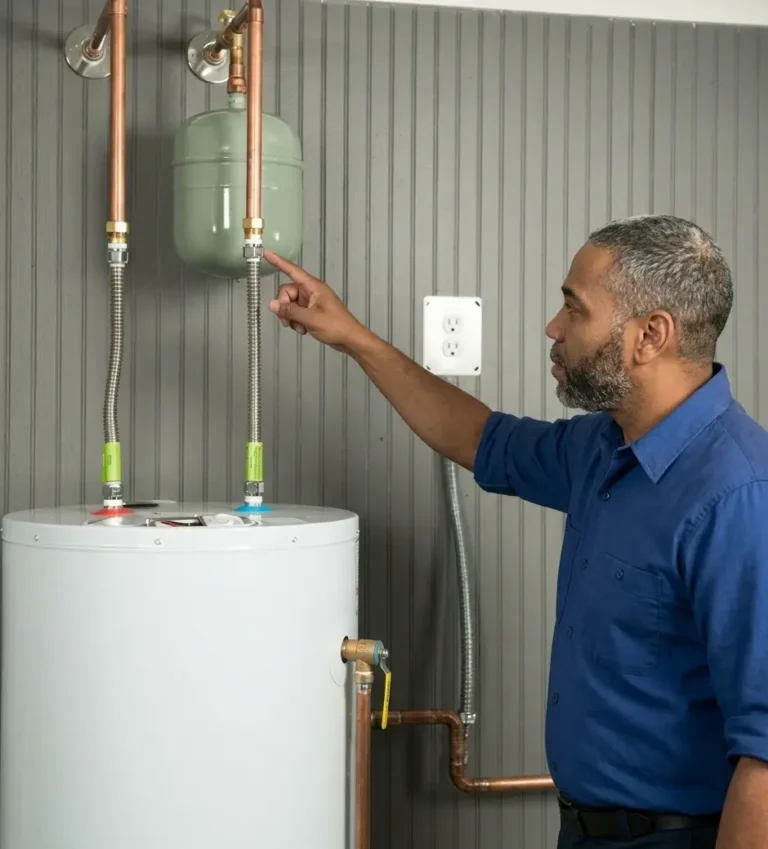
Water heaters leak at points where pressure, heat, and repeated use place continuous stress on components. These locations are predictable. Top-mounted connections carry constant inflow and outflow, which weakens seals over time. As these seals degrade, small leaks begin to form around fittings.
Valves introduce another failure point. The pressure relief valve is designed to release excess pressure, but when internal components wear out or pressure becomes unstable, it may begin leaking under normal conditions. Drain valves at the base of the unit are also exposed to sediment buildup, which interferes with sealing and leads to slow leakage.
Internal tank leaks represent a different level of failure. Corrosion develops inside the tank as protective layers wear down. Once corrosion progresses far enough, the tank wall loses integrity and water escapes from the base. At this stage, the structure can no longer contain pressure, and repair is no longer possible.
Leak Location | What It Indicates | Required Action |
Top connections | worn seals or loose fittings | reseal or replace fittings |
Pressure relief valve | pressure imbalance or valve wear | replace valve |
Drain valve | sediment interference or valve degradation | repair or replace |
Tank base | internal corrosion and structural failure | full replacement |
Every heating cycle increases internal pressure as water expands. The system relies on valves and structural strength to regulate that pressure. Over time, these control mechanisms weaken. Seals lose elasticity, valves become less responsive, and materials begin to fatigue.
Heat accelerates this process. Continuous expansion and contraction create stress at the microscopic level. Small material changes accumulate into structural weakness. Sediment buildup makes the problem worse by reducing heat transfer efficiency. The system compensates by extending heating cycles, which raises both temperature and pressure. This combination intensifies stress across the entire unit.
A leak forms when pressure is no longer distributed evenly. Instead of being controlled, it concentrates at weak points. Once those points fail, water escapes.
Leak patterns are not random. They reflect the condition of the system and indicate how far degradation has progressed. A leak at a connection point suggests localized wear. These are early-stage issues and often repairable without affecting the rest of the system.
Valve leaks indicate that pressure control is no longer stable. The system may still operate, but internal conditions are no longer balanced. This increases the likelihood of further issues developing.
Leaks from the base of the tank indicate structural failure. Corrosion has weakened the tank wall to the point where it can no longer contain pressure. This is not a repairable condition. The system has reached the end of its functional life.
When multiple leak points appear, the system is no longer stable as a whole. Each leak represents a separate failure within the same unit, and repair becomes temporary rather than corrective.
A system does not begin leaking without showing changes first. These changes reflect internal stress building toward failure. Temperature inconsistency is often the earliest sign. Uneven heating indicates that heat transfer is no longer efficient.
Noise inside the tank, especially popping or cracking sounds, points to sediment buildup interacting with heat. This increases internal pressure and reduces efficiency. Pressure irregularities also develop. Water flow becomes inconsistent, and output fluctuates under normal use.
Moisture around fittings or valves may appear before a full leak develops. These small signs indicate that seals are weakening and pressure is no longer contained effectively. Addressing these signals early prevents escalation into structural failure.

Repair costs depend on the location and severity of the leak. Replacing fittings or valves typically ranges from $150 to $500. More complex repairs involving multiple components can exceed $800. Replacement costs range from $1,000 to $5,000 depending on system type and installation requirements. Tankless systems fall on the higher end due to equipment and infrastructure upgrades.
The larger cost often comes from secondary damage. Water exposure affects surrounding materials, increasing restoration costs. A leak left unresolved can multiply total cost by two to five times, depending on how far the damage spreads.
A leak is a symptom of system imbalance, not just a failure at a single point. Repairing the visible leak without understanding the underlying condition leads to repeated issues. Pressure behavior, internal corrosion, and heat distribution must all be evaluated to determine the true cause.
A system operating under unstable pressure will continue to create stress at weak points, even after a repair is completed. This is why leaks often return in different locations. The original condition remains unchanged, and the system continues to degrade.
At DG Plumbing Services, evaluation focuses on how the system performs under actual load conditions. Pressure response, internal material condition, and overall system stability are assessed before any repair or replacement is recommended. This approach eliminates guesswork and prevents recurring failures caused by incomplete diagnosis.
If your water heater is leaking or showing early warning signs, call (832) 274-3257. A full system evaluation identifies the root cause and ensures the correct solution is applied the first time.
Can a small water heater leak turn into a big problem overnight?
Yes. Even a slow leak can spread quickly once water seeps into flooring or walls. What looks minor can escalate within hours, not days.
Why does my water heater only leak when it’s heating?
Because pressure rises during heating cycles. If a seal or valve is already weak, that extra pressure forces water out at those points.
Is it safe to ignore a tiny drip for a few days?
Not really. That drip means pressure is escaping somewhere it shouldn’t. The longer it continues, the more likely it leads to bigger failure.
Why do leaks sometimes stop and then come back?
Pressure inside the system changes throughout the day. When pressure drops, the leak may pause. When it rises again, the leak returns.
Can hard water make my water heater leak faster?
Yes. Mineral buildup from hard water increases internal stress, blocks valves, and speeds up corrosion inside the tank.
Should I drain my water heater if it starts leaking?
Only if it’s safe to do so and the leak is controlled. In many cases, shutting off the water supply is enough until a professional checks it.
Why does my water heater leak after a repair was already done?
The original repair likely fixed the visible issue but not the underlying pressure or wear problem. The system continues to fail in other areas.
Is replacing a leaking water heater always the safer choice?
If the tank itself is leaking, yes. Once the structure is compromised, repair is temporary at best and unsafe at worst.
Atascocita | Baytown| North Houston| Crosby| Kingwood | Porter | Spring | New Caney
Plumber in Humble, TX offering a wide range of services including leak detection, water heater installation, and emergency repairs.
